VILLAIN OR HERO?
Holiday gift books for kids about Donald Trump
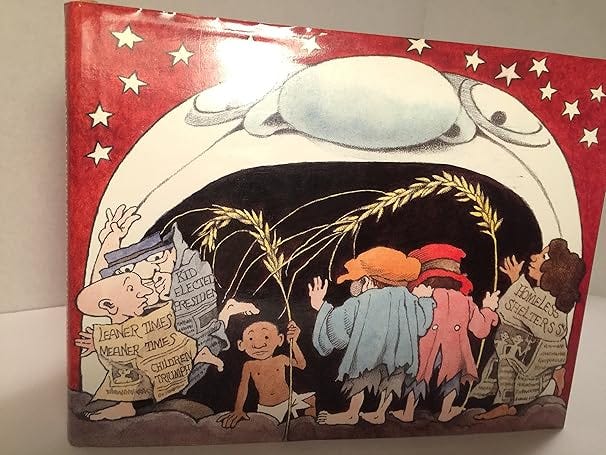
We Are All in the Dumps with Jack and Guy by Maurice Sendak, illustrated by Maurice Sendak. Copyright © 1993 by Maurice Sendak. HarperCollins Publishers.
Before he became Donald Trump’s embattled FBI director, Kash Patel, along with Donald Trump Jr., published The Plot against the King (2022), the story of a woman named Hillary Queenton who spreads lies that King Donald worked with the Russionians to become king.
That is only one of many children’s books about Trump, M. Tyler Sasser writes in Children’s Literature. Sasser adds: “Numerous books have emerged that continue to map onto Trump the narrative of a flawless president, with just as many books casting him as a new archetypal villain. These representations highlight a type of villainy that combines unchecked capitalism, sexism, racism, and bullying while commenting on wealth inequality and white masculinity.”
Some examples cited by Sasser:
Arthur Yorinks’s Christmas in July (1991) humorously depicts the story of a tempestuous, wealthy, New York businessman named “Rich Rump” who steals Santa Claus’s pants, in turn postponing Christmas for several months until his “icy heart” warms and he returns the pants.
Maurice Sendak’s We Are All in the Dumps with Jack and Guy (1993). Sendak reappropriates two nursery rhymes to illuminate how Trump’s corrupt business practices (the dumps) have considerably harmed children (Jack and Guy) by inspiring violence, disrupting communities, and ignoring a health crisis—all ironically prescient of Trump’s presidential actions during COVID-19 and the 2020 election...Juxtaposing the unrelenting capitalism associated with the Trump Tower with the suffering in the streets…Sendak dresses these children in newspapers with headlines advertising cheap real estate, poor mortgage deals, the failings of big banks, starvation, food relief shortages, and homelessness... The images of children living in boxes look eerily like the results of Trump’s so-called “Zero Tolerance” immigration policies.
Maya Gonzalez’s When a Bully Is President: Truth and Creativity for Oppressive Times (2017), never names Trump but clearly evokes the then sitting president with its title.
Virginia Sobol and Sarah Daly’s Time Out, Donald! (2018), is a caricature of young Donald Trump who “gets put into time out almost every day at preschool.” Each subsequent page depicts Donald bullying his classmates by name calling, theft, refusing to pick up his toys, ridiculing those who accidentally fall on the playground, and so on. After each episode, the narrator asks readers to consider what they would do if put in the same position. The book is dedicated to “children who treat others with kindness, respect and generosity.”
In Harry Bliss’s Grace for Gus (2018), Trump again is depicted antagonistically as a predator. After saying goodnight to her fathers, Grace sneaks out of her Manhattan apartment and spends her night raising money for the class hamster by drawing caricatures, playing the violin, and dancing as a street performer. In one image, as she descends into the subway, readers see the name of “Rump Tower” in the background, a playful jab at Trump’s narcissistic need to place his name on everything.
In Joshua Siegal and Amélie Falière’s Morris Wants More (2017), the Trumplike caricature Morris “lives in a HUMONGOUS house, with lots and lots of toys.” Further, Morris is depicted in a dark suit and red tie, with a button on his chest with either the letter “P,” suggesting “President,” or the letter “D,” suggesting “Donald.”
Susan Cooper’s The Boggart Fights Back (2018) portrays American real estate developer William Trout who generally “wore his trademark black Trout jacket with the bold yellow T on its back,” but changes costumes when he flies to Scotland to break ground on a new hotel: “Mr. Trout was dressed very formally . . . in a dark suit, white shirt, and red tie.” With Trout as the Trump stand-in, the narrative establishes the central conflict: that the development of the Trout Castle Resort on the unspoiled loch in Scotland will be debilitating for the local economy (since tourists will mostly spend money inside the resort) as well as the environment (since it will eliminate a local seal population). Trout’s resort is not aimed at blocking people from entering the loch, but the natives to the loch—Nuckelavee, the Boggart, Nessie, and the seals—rightfully recognize Trout as a threat to their native home. The comical climax of the novel occurs when these creatures attack Trout, who falls into the loch and comes face to face with those whom his construction most harms. They toss Trout in the air, slap him around with their tails, and terrify him with their growls before letting him go. Embarrassed and terrified by his run-in with the loch’s occupants, Trout has his entourage promise never to share with the press what happened, and in his final press conference, he changes his narrative completely, stating that it is because of the indigenous species living in the area that he will build elsewhere.
“To survey approximately three dozen books about Trump,” Sasser concludes, “is to survey the cultural divide in contemporary America, where through children’s literature young citizens are inundated by texts mythologizing, villainizing, and supporting [Trump]...Trump’s influence on contemporary children’s literature and the controversy surrounding several mainstream presidential biographies exposes how educational books are no longer able to mythologize American presidents without significant cultural backlash.... To survey Trump’s highly contentious presence throughout multiple genres of children’s literature is to witness the ways publishers grapple with American history, awareness, mythology, indoctrination, and even supply and demand. Putting these texts in conversation with one another attends to the complex influence Trump maintains throughout children’s culture and clarifies the dire need to take seriously how readers understand presidential history.”
Source:
“Trump and Children’s Literature,” M. Tyler Sasser, Children’s Literature, Volume 51 (2023), pp. 150-181
Most of the titles above are available at local bookstores