DRINKING THE KOOL-AID
Poison and Isolation in America

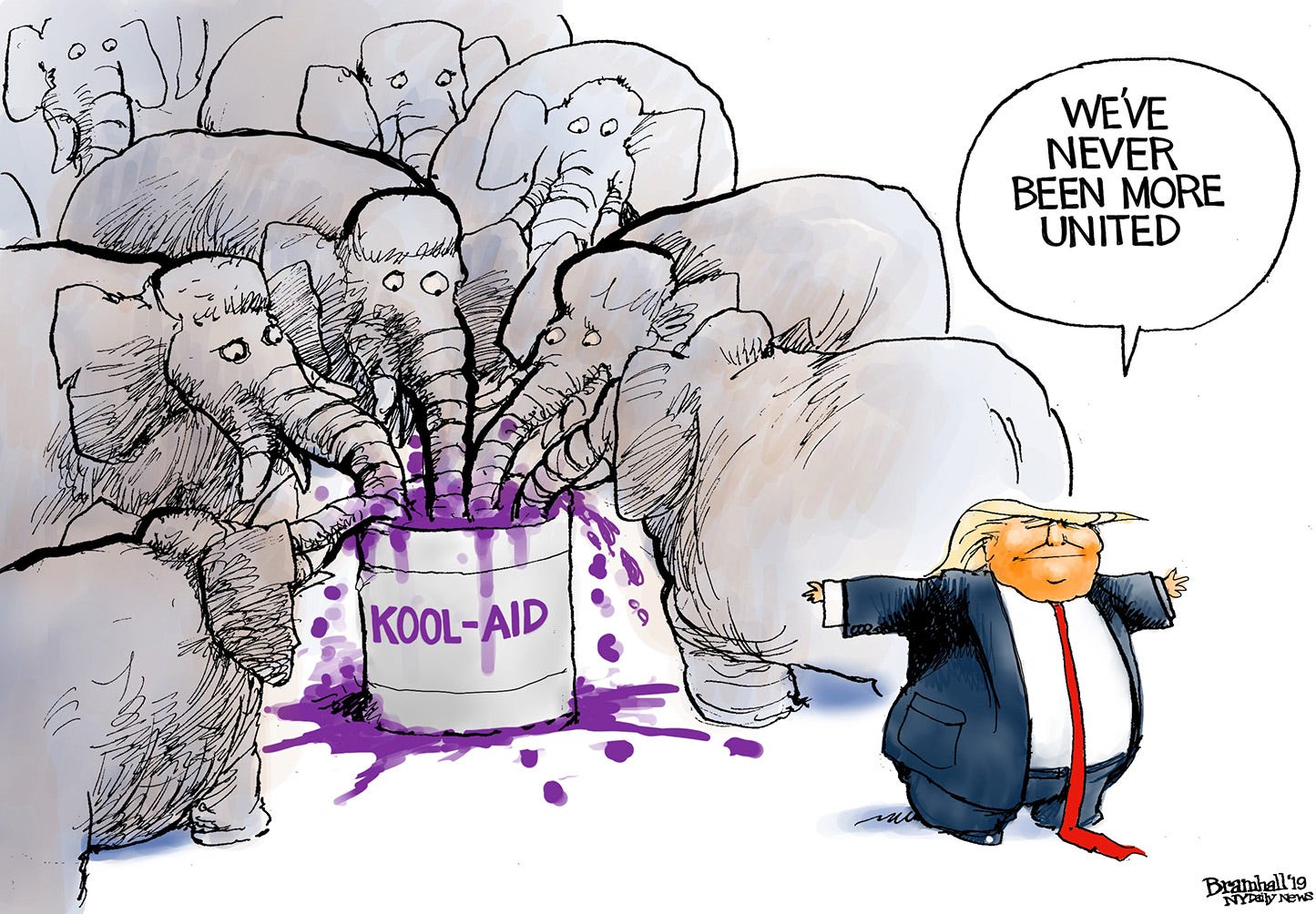
“How many of us are so desperate for a charismatic leader claiming to have the answers that we will surrender our basic instincts for survival, along with our reason?” Stephen Holden writes in his 2006 New York Times review of the movie ‘Jonestown: The Life and Death of Peoples Temple’ “... the horror of Jonestown was caused by people’s willingness to surrender their reason to a madman who was also a charismatic manipulator. And that can happen anytime and anywhere.”
The 1978 deaths of Jim Jones and 900 followers in the jungles of Guyana have become synonymous with the growth of cults in American culture. Like Jones, Donald Trump has made a career of manipulating others and gathering loyal followers.
Most of Jones’ followers died after drinking poisoned Flavor Aid (not Kool-Aid). Since then, however, “drinking the Kool-Aid” has become synonymous with poisoning the mind. “It started as a byword for unthinking followers,” Susannah Crockford writes in Nova Religio, “and then became an indicator of loyalty when utilized in business and sports discourse.” She adds:
It continues to appear as an insult in political contexts...It implies how the authority of a few can take over and dictate the terms of life and death to the many. It is a slippery symbol that can signify both the lethal result of being physically poisoned and the mental effects of being psychologically influenced and damaged by another.
Steven Hassan, a cult expert who has written several books about deprogramming, including The Cult of Trump, talked to Tess Owen of Wired about how to approach people who have been brainwashed by MAGA. “It’s important to understand that the MAGA identity is fused with Trump and its ideology,” Hassan said. “And what doesn't work is trying to attack the leader, the doctrine, the policy of any cult. Trying to argue with logic or with facts is counterproductive, because it activates the cult identity to label you as an enemy that is persecuting them.
“What I have always been advocating for years is: Stay warm, stay loving, don’t say ‘you’re stupid’ for following Trump or ‘you’re a moron,’ but just be warm and say ‘I don't understand, help me step into your shoes. The most powerful technique is to ask questions that empower the person to think and reflect.”
Another key part of effective deprogramming, Hassan adds, is to remind the person who they were prior to being brainwashed.
Jonestown also is emblematic of isolated communities. In 2013, right-wing talk radio host Glenn Beck announced plans for a city he called Independence, USA. (It was never built). It would have been modeled on Ayn Rand’s utopian community, Galt’s Gulch. Beck said his utopia would be a self-sustaining city and theme park hybrid that would harken back to a time of a simpler America, built on values he saw the country “going away from.”
Beck’s city, author Bill Bishop told Katrina Clarke of the National Post, would be an extreme version of a pre-existing trend. In The Big Sort, Bishop argues that American communities are becoming more insular and similar internally and “simultaneously increasingly different from one another. As a result, red states are becoming redder and blue states are becoming bluer — and this is happening even at the neighborhood and city level.” According to Bishop:
Places are becoming more alike in the way families are formed and the way they vote and education levels... People are trying to find those places where they can find reinforcement from others who are like themselves.
[But] There are risks with such insular communities.
It’s limiting what people see. Whenever you isolate yourself in a community that is increasingly like-minded then you’ll have a limitation on the number of ideas that are available.
There is less of a chance for people to understand those who are different from them if they stay in their isolated community, while mixed communities become more tolerant of differences.
The problem with having a like-minded community is that over time it becomes more extreme in the way that people are like-minded.
America is increasingly divided between red and blue, MAGA and the rest of us. Despite the wide variety of news sources, most Americans rely on print and broadcast outlets that echo and reinforce their views. Ubiquitous social media further amplify our divisions. Fact checking has been replaced by the addictive rush of clicks and likes. As difficult as it may be, we need to read, listen and view sources of information that don’t necessarily confirm our biases. And we need to listen and talk to those with whom we disagree.
Sources:
“Kool-Aid, Craziness and Utopian Yearning,” Stephen Holden, New York Times, October 20, 2006
“How Do You Know When You're in a Cult? The Continuing Influence of Peoples Temple and Jonestown in Contemporary Minority Religions and Popular Culture,” Susannah Crockford, Nova Religio, Vol. 22, no. 2, November 2018
“Inside Independence, USA, Glenn Beck’s proposed self-sustaining city and theme-park hybrid,” Katrina Clarke, National Post, January 22, 2013
“People Are Trying to ‘Deprogram’ Their MAGA Parents Through Book Clubs,” Tess Owen, Wired, August 19, 2025